Cartographic Studies
A Cartography of the Four Elements
How Fire, Water, Earth, and Air actually behave in love
It is late. The kitchen is quiet. A couple stands at the counter. She is Fire-leading, Water-secondary. He is Earth-leading, Air-secondary. She turns to him and says, “You don’t see me when I’m quiet.” He answers, evenly, “You don’t see me when I’m thinking.”
Both of them are right.
And both of them are asking the same question, the one that runs underneath almost every long relationship. What are we made of, exactly? And how does what we are made of find, or fail to find, what someone else is made of?
They are not having the same conversation. They are not, in fact, made of the same materials. This is not a flaw in love. It might be the structure of it.
The word compatibility comes from the Latin com-pati, which means to feel-with, or to suffer-alongside. It is one of the most beautiful etymologies in any language, because the word itself contains a recognition that most modern usage has forgotten. To be compatible with someone is not to match them. It is to be made of materials that can feel each other’s weather.
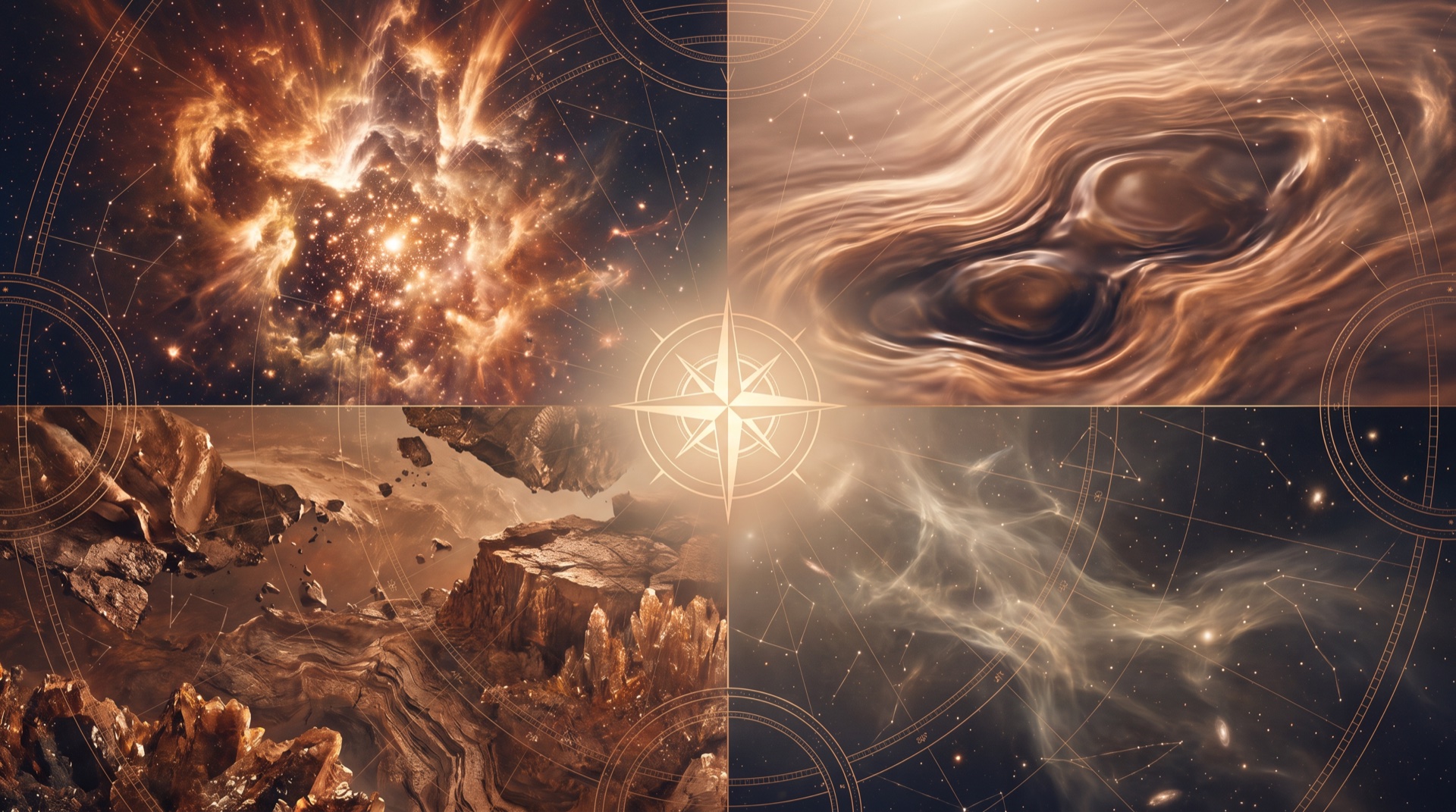
This is the territory the four elements actually map. Not personality types, not zodiac shorthand, not archetypes you fit yourself into and then discard when they don’t predict your week. The four elements are something more useful, and more boring, than any of those things. They are the substances you are made of. They are the slow weather you carry into every conversation, every silence, every long Sunday afternoon. And the slow weather your partner carries, too.
You are not one element. You are a distribution of all four, with one usually leading and another quietly behind it. Your partner is the same. The question is not whether you and your partner share an element. The question is what kind of weather your two patterns make when they meet.
This is the first of what will be called the Cartographic Studies on this site. Over the next year, each of the sixteen pairings the test produces will get its own deeper essay. This one is the map of the whole territory, drawn lightly on purpose. The detail comes later.
You are not one element. You are a distribution.
Most popular accounts of the four elements collapse the system into a typology. You are an Earth person. He is a Water type. The shorthand is satisfying because it is finite. Four things to choose from, like a personality test taken on the back of a magazine. But the shorthand is also wrong, in the way most typologies are wrong when they try to contain a person. People are not boxes. They are weather.
The test on this site reports your elemental composition as a percentage distribution across all four elements. Most readers come back with something like 35% Fire, 30% Water, 20% Air, 15% Earth. A dominant element, a secondary, and two recessive ones still doing their quiet work in the background. A few people come back with a much sharper concentration, fifty percent in one element and the others distantly behind. A small number come back almost evenly weighted across all four, which is its own kind of pattern, and one of the most beautiful.
The dominant element tells you what someone leads with. The secondary tells you what they return to when the leading element is exhausted. Fire-Water, in that order, leads with action and returns to feeling. Water-Fire leads with feeling and returns to action. The two profiles share both elements but live entirely different inner lives.
This is why the same-element conversation is not the conversation worth having. “Are you a Fire person? So am I,” tells you almost nothing. “What is your secondary?” tells you considerably more. And “How do your dominant and secondary speak to each other when no one else is in the room?” tells you almost everything.
Four elements. Sixteen distributions. The distance between those two numbers is the distance between astrology and cartography. Astrology predicts. Cartography observes.
What each element does in love
The four elements are not personality traits. They are jobs. Each one does a particular kind of work in a relationship, and your distribution determines which kinds of work you do most fluently and which you have to learn.
Fire is the element of declared appetite. It is the willingness to want first, to admit attraction, to advocate for a need, to fight for someone in plain language, to take the action no one else wants to take. People high in Fire move toward what they want without first checking whether they are allowed to want it. In love, this looks like the partner who initiates, who protects, who introduces tension into a system that has gone too still. Fire’s gift is contagious heat. Fire’s cost is exhaustion, its own and the room’s. The Sanskrit word for fire is agni, which is etymologically the same word as the Latin ignis, the root of the English ignite. The element is older than any of the languages that try to name it.
Water is the element of attunement. It is the capacity to sense an emotional weather pattern in a room before anyone has named it, to know what is wrong with someone you love before they have figured it out themselves, to hold space for grief without rushing toward repair. People high in Water are reading the room continuously, often without realizing they are doing it. In love, this looks like the partner who notices the small change in your voice on the phone. Water’s gift is the soul-level recognition. Water’s cost is the absorption of weather that is not theirs to carry.
Earth is the element of the kept promise. It is the texture of being shown up for. The standing dinner reservation, the noticed anniversary, the partner who is exactly where they said they would be at the time they said. Earth is not glamorous. Earth is the ground that does the slow work love actually requires when nothing dramatic is happening, which is most of the time. People high in Earth build rituals that hold a relationship together when neither person feels like holding it together. Earth’s gift is reliability that does not perform itself. Earth’s cost is the slow erosion of surprise.
Air is the element of clarity. It is the impulse to articulate, to name a thing precisely, to find the framing that makes a difficult conversation possible. People high in Air see relationships from a slight altitude. They can describe what is happening between two people while it is still happening. In love, this looks like the partner who can say, calmly, “I think we’re having two different arguments right now,” and untangle the knot. Air’s gift is the question that makes the answer possible. Air’s cost is occasionally explaining a feeling instead of having it.
These four jobs, declaring, attuning, keeping, clarifying, are all necessary in any long relationship. No two people share them evenly. The way the work gets distributed between you is what your distribution actually tells you.
What is older than this map
The four elements are not new. They are not even astrology’s invention. They are one of the oldest patterns humans have used to describe the cosmos, and themselves.
Empedocles, the Greek philosopher writing in the fifth century before the common era, was the first in the Western tradition to name them. He called them rhizōmata, the four roots, and he wrote that they were not static. They were governed by two great cosmic forces, Philia, love, and Neikos, strife. The world we live in, he said, is what those two forces make of the four roots. Twenty-five hundred years later, the mapping continues. Every relationship anyone has ever watched closely is a small theater of Philia and Neikos working on the four roots of two people at once.
But Empedocles was not the first. The Vedic tradition of India, in texts written centuries before him, had already named the Pancha Mahabhuta, the five great elements: pṛthivī (earth), āpas (water), agni (fire), vāyu (air), and ākāśa (ether, or space). The element of ether, sometimes translated as spirit, or as the field that holds the others, is what most Western traditions later forgot. Some accounts treat it as a fifth element. Others treat it as the medium through which the four others move. The second reading is the more interesting one.
The Egyptian cosmology had its own version. Geb, the earth. Nut, the sky. Ra, the sun and the fire. Nun, the primordial waters. Four cosmic principles braided into the order of Ma’at, the goddess of cosmic balance, whose name was also a noun, also a verb. The word for truth, and measure, and the way things are when they are in their right relation. The Egyptians did not separate cosmology from ethics. To live in alignment with the elements was to live in Ma’at.
The medicine wheels of many Indigenous nations of North America associate the four cardinal directions with four elements. East is air. South is fire. West is water. North is earth. Each direction carries lessons about the season of life it governs. The Chinese tradition recognizes five elements, wood, fire, earth, metal, water, and an entire cosmology of how they generate and overcome one another in cycles.
What this means is that what people are doing now, when they say I am a Fire person, is something humans have been doing for at least three thousand years, in at least a dozen languages, on every inhabited continent. The pattern is not being invented here. It is being continued. There is something humbling in that, and also something steadying.
There is a deeper layer that the ancient traditions saw, and that most modern accounts have forgotten. The four elements are not, by themselves, masculine or feminine. But within the four, there is a polarity that almost every tradition recognized. Fire and Air, the active elements, the ones that project, declare, and illuminate, were associated with what some traditions call yang, the masculine principle, what Jung would later call the animus. Water and Earth, the receptive elements, the ones that hold, absorb, and sustain, were associated with yin, the feminine principle, what Jung would call the anima.
This polarity is not about gender. A man whose distribution is heavy in Water and Earth carries a strong inner feminine, a strong anima, in the architecture of his being. A woman heavy in Fire and Air carries a strong inner masculine, a strong animus. Most people carry both, in some proportion, all the time. This is part of why the test reports a distribution and not a type. You are not one thing. You are something closer to a small cosmos.
The implication is the part worth lingering on. If each person is already a small cosmos, already containing fire and water, earth and air, masculine and feminine, in some weather pattern of their own, then a relationship is not the meeting of two halves. It is the meeting of two complete cosmoses. Each one whole. Each one carrying the polarities the other carries, in different proportions. The old idea that we are looking for our missing half is wrong. We are looking for a whole world that can meet our whole world without one of them having to disappear.
What the sixteen distributions map is not who completes whom. They map which weather meets which weather, when two whole worlds find each other.
Why sixteen, not four
Once you account for both the dominant element and the secondary, the four elements become sixteen distributions. Each one is a distinct relational pattern, and each one has been given a name in this work, a tagline that tries to describe what the pattern actually feels like from the inside.
These names are not box labels. They are short observations. The full essay on each will come later. For now, here is the territory, briefly.
Fire-led.
- Fire-Fire, “Two flames, one room.” Declared appetite meeting declared appetite. The hottest pairing on the map. Highest urgency, highest visibility, highest combustion. The pattern that tends to either consolidate fast or burn through itself within a year.
- Fire-Water, “Steam: what heat does to depth.” Bold action breaking itself open into feeling. The fierce protector who is also the quiet healer. The most internally contradictory of the Fire-led profiles, and often the most magnetic.
- Fire-Earth, “Fire kept by stone.” Heat with a slow base. The partner who acts with conviction and also keeps the promise made on the way out the door. Common in long-tenured relationships that look quiet from the outside.
- Fire-Air, “Fire that thinks before it moves.” Declared appetite with a strategist’s mind. Contagious in a room, devastating in a debate. Often the partner who plans the fight and also wins it.
Water-led.
- Water-Fire, “The cool answer to heat.” Feeling that finds itself willing to act. Empathy with a steel spine. The partner who feels everything and still moves toward it.
- Water-Water, “Depth recognizing depth.” Two oceans. Capable of the most absolute intimacy, and also of merging until neither person can find their own coastline. Pairs whose closeness is mistaken for codependence by people who have not lived inside it.
- Water-Earth, “Water finding stillness.” Feeling laid down on solid ground. Sensitive without being unstable, reliable without being shut. Often quietly, ordinarily happy.
- Water-Air, “Mist: what feeling does to thought.” Emotion translated into language. The partner who reads what you have been carrying and gives you the sentence for it.
Earth-led.
- Earth-Fire, “Stone with fire underneath.” Reliability with a hidden urgency. The slow-burner whose convictions do not appear until they are already final.
- Earth-Water, “Ground that drinks.” Solid presence with deep wells. Holds others without losing self. The partner you call when the world is ending.
- Earth-Earth, “Stone meeting stone.” The committed pair. Safest of the sixteen. Slowest to surprise itself, but also slowest to lose itself. The relationship that lasts not because the elements are exciting, but because they are mutual.
- Earth-Air, “Mountain learning to think.” Loyalty with perspective. Patient and strategic at once. Often shows up in long marriages and long friendships with the same texture.
Air-led.
- Air-Fire, “Wind making the flame larger.” Ideas that catalyze action. The pair that talks each other into being braver. Most likely to start projects together.
- Air-Water, “Sky reading water.” Intellect attuned to feeling. The pattern reader. The partner who sees you not just clearly but kindly.
- Air-Earth, “Sky finding ground.” The thinker who also keeps the calendar. Articulate plus dependable. Often quietly the most successful pairing in stable middle life.
- Air-Air, “A mind in conversation with itself.” Two thinkers. Highest rapport in conversation, lowest in the body. Pairs who fall in love over text and have to learn, over time, the language of the unspoken.
You can see the pattern. Each profile pairs a leading job with a returning one. None of these is a verdict. Each is a starting point, a small description of the weather you walk into a room with.
What the meeting of two patterns actually looks like
When two profiles meet, three rough kinds of weather emerge.
Same-element meetings, Fire with Fire, Water with Water, Earth with Earth, Air with Air, produce instant recognition. The first conversation feels uncannily familiar. There is a low cost of entry and a low pressure to translate, because each partner already speaks the other’s leading language. What gets missed in same-element pairings is the friction that normally produces growth. The risk is the echo chamber. Two people confirming each other’s dominant element and starving the recessive ones, until the relationship becomes a single weather system without seasons.
Adjacent-element meetings, Fire with Earth, Water with Air, and their reverses, are the complementary pairs. Each partner provides exactly the element the other most lacks. The Fire-leading partner brings declared appetite to a relationship that might otherwise stall in deliberation. The Earth-leading partner brings the kept promise that prevents the heat from burning everything down. These pairings tend to be the steadiest over decades. They are also, quietly, the ones most likely to bore each other if the recessive elements are not deliberately fed.
Opposite-element meetings, Fire with Water, Earth with Air, are the dramatic pairs. They contain the most internal contrast and produce the most transformation. They are also the most volatile. Fire-Water pairings, in particular, become the steam pattern, heat changing what depth knows about itself. The brand’s own name for these is the combustion-and-condensation pairings, and they are responsible for both the most unforgettable love and the most spectacular endings.
None of these patterns is better than the others. The cartography is not about finding the best weather. It is about knowing the weather you are actually living in. And then, this is the part most people skip, deciding what to do with the knowing.
On boxes, and what this isn’t
The first objection any reader of this kind of work is right to raise is that people are more complicated than four elements.
They are.
People are more complicated than every framework that has ever been proposed about them. Empedocles’ four roots, the Vedic five, Jung’s typologies, attachment theory, the Big Five, the love languages. None of those frameworks holds up under the full weight of any actual person. They are not meant to. They are meant to give you a vocabulary specific enough to pay attention with.
The reason vocabulary matters is that attention without language collapses back into mood. Something is off between us this week is the sentence of a relationship that has run out of language. I am Fire-led and exhausted, and you are Earth-led and unmet, and we have been doing each other’s recessive work for a month is the sentence of a relationship that can be repaired. The cartography is not a substitute for the partnership. It is a map you can lay over the partnership when you need to see where you are.
There is also the second reasonable objection, which is whether this is just astrology with extra steps. It is not, and the difference is worth being precise about. Astrology predicts what will happen, on the basis of patterns you cannot verify. A cartographic study describes what is already happening, and gives it a name. The test on this site does not predict whether you will fall in love. It describes the materials you bring when you do.
And for anyone whose result lands them in a pairing with a partner whose elements look incompatible, there is no incompatible pairing. There are pairings with different costs and different gifts. The Earth-Earth couple is not better than the Fire-Water couple. It is just being asked to do different work. Knowing which work your particular pairing is being asked to do is the entire point of having the map.
A last thing, before the invitation. Knowing your elements does not solve your relationships. No framework has ever solved a relationship. What close attention does is repair things, slowly, over time. The framework is just the lamp you carry into the dark. What you do once you can see is older than any map.
The first map
The test takes about fifteen minutes. It will show you your distribution, your dominant, your secondary, and the small geography of how you are made. It will also show you the geography of the partners you are likely to be made-with-well, and the geography of the partners you are likely to find yourself burning with.
This is the first map. There are sixteen more, drawn slowly, here, over the next year, one profile at a time. Field notes from the observatory floor, written for the people who suspected they were paying attention to something real and just did not have a vocabulary for it yet.
Begin where the test begins.
A note on what is missing from this map: degrees. The test reports percentages, but this essay has treated the dominant element as if it were a fixed leader. A 35% Fire-led life looks meaningfully different from a 50% Fire-led life. The next Cartographic Study will take up the question of intensity, how much of an element you are, not just which element leads. Octavio Paz, in La llama doble, describes love as the convergence of three flames: the original flame of sex, the red flame of eros, the blue flame of love. Three flames, four elements, two whole cosmoses meeting. The patterns rhyme.